Your cart is empty

Yin-Yang Balance
The fundamental concept of complementary opposites that creates harmony in the universe and within ourselves. Daoist practices at Wudang focus on balancing these energies for health and spiritual growth.
Discover the profound heritage of Wudang Mountain, where Daoist
SACRED MOUNTAIN
Wudang Mountain has been a center of Daoist practice for over a thousand years, with a rich history that intertwines spirituality, martial arts, and imperial patronage.
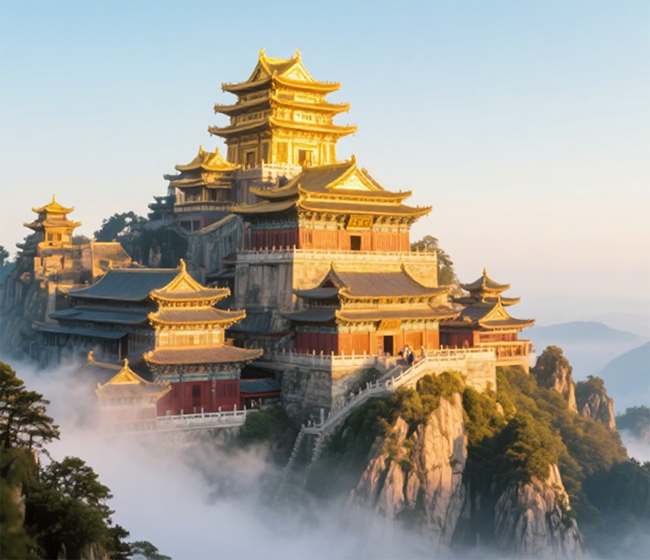
Nestled in Hubei Province, China, Wudang Mountain has been revered as a sacred Daoist site since the Tang Dynasty (618–907 AD). Its 72 peaks, 36 cliffs, and 24 valleys create a landscape of breathtaking natural beauty that has inspired spiritual seekers for centuries.
During the Tang Dynasty, the first Daoist temples were established on Wudang Mountain, marking the beginning of its spiritual significance.
Emperor Yongle of the Ming Dynasty ordered the construction of the "Taoist Vatican" — a complex of 9 palaces, 9 monasteries, 36 nunneries, and 72 temples.
Wudang Mountain was designated a UNESCO World Heritage Site, recognizing its exceptional cultural and architectural significance.
SPIRITUAL PHILOSOPHY
Daoism at Wudang Mountain emphasizes harmony with nature, inner cultivation, and the pursuit of longevity through balanced living.
The fundamental concept of complementary opposites that creates harmony in the universe and within ourselves. Daoist practices at Wudang focus on balancing these energies for health and spiritual growth.

The art of "non‑action" or effortless action. This principle teaches practitioners to align with the natural flow of life rather than forcing outcomes, leading to greater harmony and effectiveness.

Wudang Daoism emphasizes deep connection with the natural world. The mountain’s landscape is considered a living embodiment of Daoist principles, with its peaks, valleys, and forests serving as natural temples.
INTERNAL POWER
Wudang is renowned as the birthplace of internal martial arts, where physical techniques are integrated with spiritual cultivation and energy work.
Unlike external martial arts that emphasize physical strength, Wudang martial arts focus on developing internal power (neijia) through the cultivation of qi (vital energy). These practices integrate movement, breath, and intention to create a harmonious system of self‑defense and self‑cultivation.

The most famous Wudang art, known for its slow, flowing movements that cultivate internal energy and promote health.
Characterized by circular footwork and continuous turning movements that develop agility and internal power.
A more linear martial art that channels internal energy through five elemental movements.
An elegant weapon form that combines martial technique with spiritual cultivation.
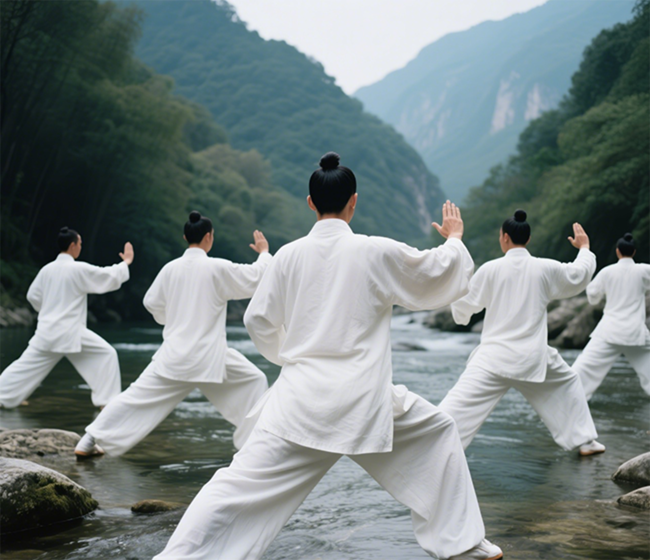
Wudang culture encompasses a holistic approach to health and longevity, integrating movement, meditation, diet, and herbal medicine to create balance and harmony within the body and mind.

Practices that develop and circulate vital energy through breathing techniques, meditation, and movement.

Traditional herbal formulas developed over centuries to support health, vitality, and spiritual clarity.

Nutrition based on Daoist principles, emphasizing seasonal, balanced eating for optimal health.

Techniques to calm the mind, develop inner awareness, and connect with the universal Dao.